How the Appalachian dulcimer makes its sound
In the Hornbostel–Sachs system, which classifies instruments by how they produce sound, the Appalachian dulcimer belongs to the board zithers: strings are stretched across a flat board or box – the family of the piano, harpsichord and hammered dulcimer.
More broadly it is one of the chordophones (string instruments), where sound comes from vibrating strings, amplified by a resonating body.
Players shape its sound through technique and materials; the resonating body filters the raw vibration, boosting some harmonics and damping others.
From Wikipedia
The Appalachian dulcimer (many variant names; see below) is a fretted string instrument of the zither family, typically with three or four strings, originally played in the Appalachian region of the United States.
The body extends the length of the fingerboard, and its fretting is generally diatonic.
Other board zithers


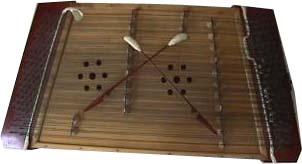


More instruments from United States





Frequently asked questions
What does the Appalachian dulcimer sound like?
As one of the board zithers, its sound comes from the way strings are stretched across a flat board or box.
What type of instrument is the Appalachian dulcimer?
It is classified as board zithers (Hornbostel–Sachs 314-122-5).
Where does the Appalachian dulcimer come from?
The Appalachian dulcimer originates from United States.
Sources & credits
- Wikidata Q2145031 – CC0
- Wikipedia: Appalachian dulcimer – CC BY-SA 4.0
- Image by MatthewVanitas – CC BY-SA 3.0