How the aeolian harp makes its sound
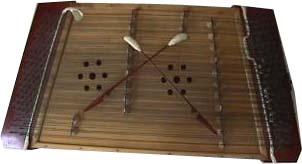
In the Hornbostel–Sachs system, which classifies instruments by how they produce sound, the aeolian harp belongs to the board zithers: strings are stretched across a flat board or box – the family of the piano, harpsichord and hammered dulcimer.
More broadly it is one of the chordophones (string instruments), where sound comes from vibrating strings, amplified by a resonating body.
Its timbre – the colour that lets you tell it apart from other instruments playing the same note – comes from the mix of overtones its body and resonator emphasise.
From Wikipedia
An Aeolian harp (also wind harp) is a musical instrument that is played by the wind. Named after Aeolus, the ancient Greek god of the wind, the traditional Aeolian harp is essentially a wooden box including a sounding board, with strings stretched lengthwise across two bridges. It is often placed in a slightly opened window where the wind can blow across the strings to produce sounds. The strings can be made of different materials (or thicknesses) and all be tuned to the same pitch, or identical strings can be tuned to different pitches. Besides being the only string instrument played solely by the wind, the Aeolian harp is also the only string instrument that plays solely harmonic frequencies. They are recognizable by the sound which is a result of this property, which has been described as eerie and ethereal.
Other board zithers




Frequently asked questions
What does an aeolian harp sound like?
As one of the board zithers, its sound comes from the way strings are stretched across a flat board or box.
What type of instrument is the aeolian harp?
It is classified as board zithers (Hornbostel–Sachs 314.122).
Sources & credits
- Wikidata Q255358 – CC0
- Wikipedia: Aeolian harp – CC BY-SA 4.0
- Image by ? (Knight's American Mechanical Dictionary) – Public domain