Listen to the tuba
Tip: press play to see the sound's live frequency spectrum in blue over the waveform.
How the tuba makes its sound
In the Hornbostel–Sachs system, which classifies instruments by how they produce sound, the tuba belongs to the brass (lip-vibrated aerophones): the player's buzzing lips set the air column vibrating – trumpets, horns, trombones, tubas and the didgeridoo.
More broadly it is one of the aerophones (wind instruments), where sound comes from vibrating air.
Its timbre – the colour that lets you tell it apart from other instruments playing the same note – comes from the mix of overtones its body and resonator emphasise.
Range of the tuba
The typical range of the tuba runs from D1 (36.7 Hz) to F4 (349 Hz) – about 3.2 octaves. Harmonics extend its sound far higher.
From Wikipedia
The tuba (Latin, "trumpet"; UK:; US: ) is a large brass instrument in the bass-to-contrabass range. It is a member of the valved bugles, a large and diverse family of instruments characterized by their wide conical bore and use of valves to alter pitch. The tuba usually has four or five valves, although some models have three or six. Descending from the serpent and ophicleide, the tuba was invented in Prussia by Wilhelm Friedrich Wieprecht and Johann Gottfried Moritz and patented in 1835 as the Baß-Tuba, pitched in 12-foot (12′) F. Its five valves provided a fully chromatic contrabass instrument with a deep, full contrabass timbre.
Other brass

Trumpet
Brass (lip-vibrated aerophones)

Trombone
Brass (lip-vibrated aerophones)

French horn
Brass (lip-vibrated aerophones)

Brass instrument
Brass (lip-vibrated aerophones)

Vuvuzela
Brass (lip-vibrated aerophones)
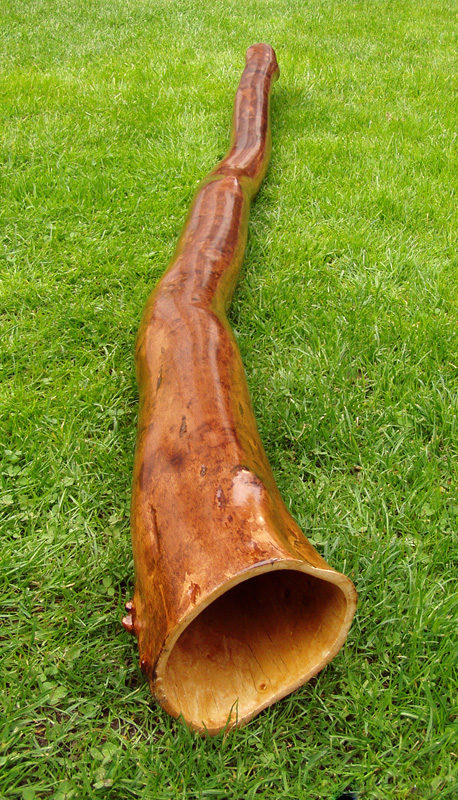
Didgeridoo
Brass (lip-vibrated aerophones)

Cornet
Brass (lip-vibrated aerophones)

Flugelhorn
Brass (lip-vibrated aerophones)
Questions people ask
Real questions from the Stack Exchange community – follow a link to read the discussion.
Frequently asked questions
What does a tuba sound like?
Listen to 3 recordings on this page. As one of the brass, its sound comes from the way the player's buzzing lips set the air column vibrating.
What type of instrument is the tuba?
It is classified as brass (lip-vibrated aerophones) (Hornbostel–Sachs 423.232).
Sources & credits
- Tuba-range-C-high – Public domain · Wikimedia Commons
- Tuba-range-C-low – Public domain · Wikimedia Commons
- Mozart - Requiem (Krips) - IV. Tuba mirum by Wolfgang Amadeus Mozart – Public domain · Wikimedia Commons
- Wikidata Q131168 – CC0
- Wikipedia: Tuba – CC BY-SA 4.0
- Image by Buffet Crampon – CC BY-SA 4.0