How the balaban makes its sound
In the Hornbostel–Sachs system, which classifies instruments by how they produce sound, the balaban belongs to the double-reed instruments: two reeds beat against each other – oboes, bassoons, shawms and the duduk.
More broadly it is one of the aerophones (wind instruments), where sound comes from vibrating air.
Players shape its sound through technique and materials; the resonating body filters the raw vibration, boosting some harmonics and damping others.
From Wikipedia
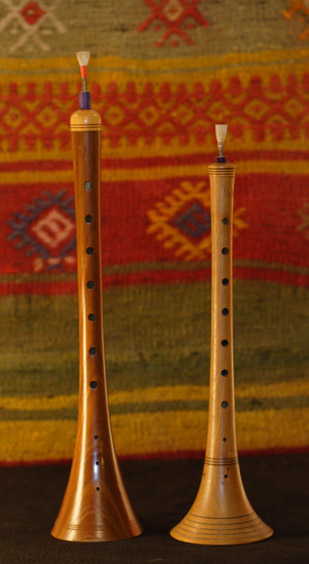
The balaban or balaman (Azerbaijani: Balaban) is a double-reed pipe with cylindrical bore, about 35 centimetres (14 in) in length, with eight finger holes and one thumb hole, which is played in the eastern part of Iran's historic Azerbaijan region as well as in the Republic of Azerbaijan (where it is also called düdük, according to the Encyclopædia Iranica). The Azeri balaban, the Turkish mey, and the Armenian duduk are almost identical, except for historical and geographical differences.
Balaban can be made of mulberry or other harder woods, such as walnut. The bore through the instrument is about 1.5 centimetres (0.59 in) in diameter. The double reed is made out of a single tube of cane about six cm long and pressed flat at one end. The performer uses air stored in his cheeks to keep playing the balaban while he inhales air into his lungs. This “circular” breathing technique is commonly used with all the double-reed instruments in the Middle East.
Other double-reed instruments




More instruments from Azerbaijan


Frequently asked questions
What does a balaban sound like?
As one of the double-reed instruments, its sound comes from the way two reeds beat against each other.
What type of instrument is the balaban?
It is classified as double-reed instruments (Hornbostel–Sachs 422.121-62).
Where does the balaban come from?
The balaban originates from Azerbaijan.