Listen to the Olive-backed oriole
Tip: press play to see the sound's live frequency spectrum in blue over the waveform.
About the Olive-backed oriole
The Olive-backed oriole is a bird in the family Oriolidae (order Passeriformes). Its conservation status on the IUCN Red List is “least concern”. Adults weigh around 96 g.
What does the Olive-backed oriole sound like?
Most birds have two kinds of vocalisation: songs, which are learned or innate phrases delivered mainly in spring and summer, and calls – brief contact, alarm and begging notes heard all year round. Listening for both helps with identification.
The recordings here are labelled as flight call, insect sounds and song. Listen for differences in rhythm, pitch and repetition – the spectrum display makes it easy to see whether a sound is a pure whistle (a thin line), a harsh call (a broad band) or a trill (rapid repeated marks).
From Wikipedia
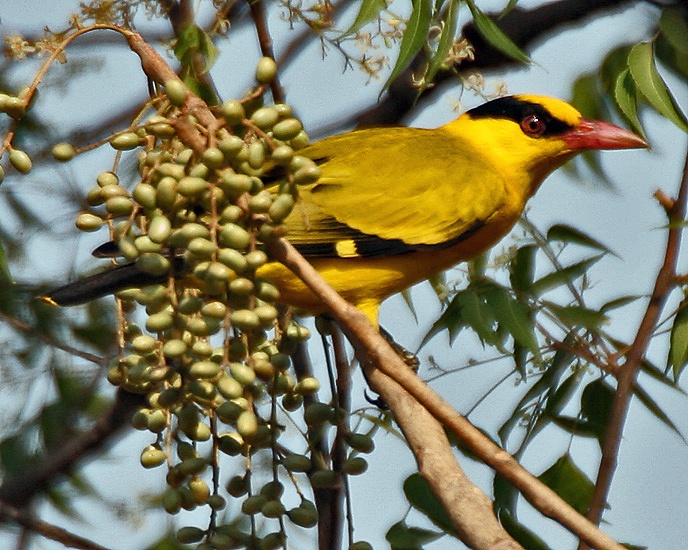
The olive-backed oriole (Oriolus sagittatus), or white-bellied oriole, is a very common medium-sized passerine bird native to northern and eastern Australia and south-central New Guinea. The most wide-ranging of the Australasian orioles, it is noisy and conspicuous.
Related birds in the genus Oriolus

Frequently asked questions
What does an Olive-backed oriole sound like?
You can hear 1 recording of the Olive-backed oriole on this page, including its flight call, insect sounds and song. Most birds have two kinds of vocalisation: songs, which are learned or innate phrases delivered mainly in spring and summer, and calls – brief contact, alarm and begging notes heard all year round.
Is the Olive-backed oriole endangered?
The IUCN Red List classifies the Olive-backed oriole as “least concern”.
What family does the Olive-backed oriole belong to?
The Olive-backed oriole (Oriolus sagittatus) belongs to the family Oriolidae in the order Passeriformes.
Sources & credits
- Flight call, insect sounds, song by James Ray – CC BY-SA 4.0 · Wikimedia Commons
- Wikidata Q1591161 – CC0
- Wikipedia: Olive-backed oriole – CC BY-SA 4.0
- Photo by Duncan McCaskill – CC BY 3.0