Listen to the Band-backed wren
Tip: press play to see the sound's live frequency spectrum in blue over the waveform.
About the Band-backed wren
The Band-backed wren is a bird in the family Troglodytidae (order Passeriformes). Its conservation status on the IUCN Red List is “least concern”. Adults weigh around 35 g.
What does the Band-backed wren sound like?
Bird vocalisations are usually divided into songs – longer, often complex phrases used to defend territory and attract mates, sung mostly by males in the breeding season – and calls: short, simple sounds for contact, alarm, begging or flight.
The recordings here are labelled as call. Listen for differences in rhythm, pitch and repetition – the spectrum display makes it easy to see whether a sound is a pure whistle (a thin line), a harsh call (a broad band) or a trill (rapid repeated marks).
From Wikipedia
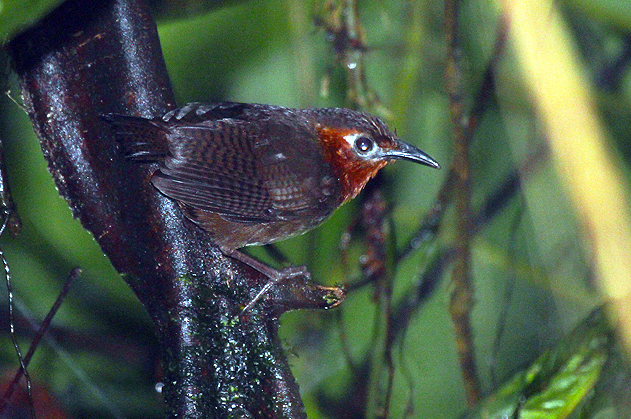
The band-backed wren (Campylorhynchus zonatus) is a small songbird of the wren family.
The band-backed wren is a resident breeding species from south-central Gulf Coast Mexico to northwestern Ecuador. It occurs in five disjunct areas, the central region being in southern Central America, in Costa Rica and northern Panama. The next two regions are northern Colombia adjacent to Panama, and 800 km to the south in northwestern Ecuador.
More from the family Troglodytidae

Eurasian wren
Troglodytes troglodytes

Northern house wren
Troglodytes aedon

Marsh wren
Cistothorus palustris

Rock wren
Salpinctes obsoletus

Carolina wren
Thryothorus ludovicianus

Bewick's wren
Thryomanes bewickii

Musician wren
Cyphorhinus arada

Grey-mantled wren
Odontorchilus branickii

Southern nightingale-wren
Microcerculus marginatus

Buff-breasted wren
Cantorchilus leucotis
Song wren
Cyphorhinus phaeocephalus

Wing-banded wren
Microcerculus bambla
Frequently asked questions
What does a Band-backed wren sound like?
You can hear 2 recordings of the Band-backed wren on this page, including its call. Bird vocalisations are usually divided into songs – longer, often complex phrases used to defend territory and attract mates, sung mostly by males in the breeding season – and calls: short, simple sounds for contact, alarm, begging or flight.
Is the Band-backed wren endangered?
The IUCN Red List classifies the Band-backed wren as “least concern”.
What family does the Band-backed wren belong to?
The Band-backed wren (Campylorhynchus zonatus) belongs to the family Troglodytidae in the order Passeriformes.
Sources & credits
- Call · Esmeraldas: 18.5 road km NNW Alto Tambo, Ecuador by Niels Krabbe – CC BY-SA 4.0 · Wikimedia Commons
- Call · Pichincha: Río Guaycuyacu, Ecuador by Niels Krabbe – CC BY-SA 4.0 · Wikimedia Commons
- Wikidata Q1586963 – CC0
- Wikipedia: Band-backed wren – CC BY-SA 4.0
- Photo by Félix Uribe from Rionegro, Antioquia, Colombia – CC BY-SA 2.0