Listen to the Acorn woodpecker
Tip: press play to see the sound's live frequency spectrum in blue over the waveform.
About the Acorn woodpecker
The Acorn woodpecker is a bird in the family Picidae (order Piciformes). Its conservation status on the IUCN Red List is “least concern”.
What does the Acorn woodpecker sound like?
Bird vocalisations are usually divided into songs – longer, often complex phrases used to defend territory and attract mates, sung mostly by males in the breeding season – and calls: short, simple sounds for contact, alarm, begging or flight.
The recordings here are labelled as call. Listen for differences in rhythm, pitch and repetition – the spectrum display makes it easy to see whether a sound is a pure whistle (a thin line), a harsh call (a broad band) or a trill (rapid repeated marks).
From Wikipedia
The acorn woodpecker (Melanerpes formicivorus) is a medium-sized woodpecker with a length of around 20 cm (8 in), and an average weight of 85 g (3.0 oz). It is found across Central America, as well as North into the western United States and South into parts of Colombia.
Related birds in the genus Melanerpes
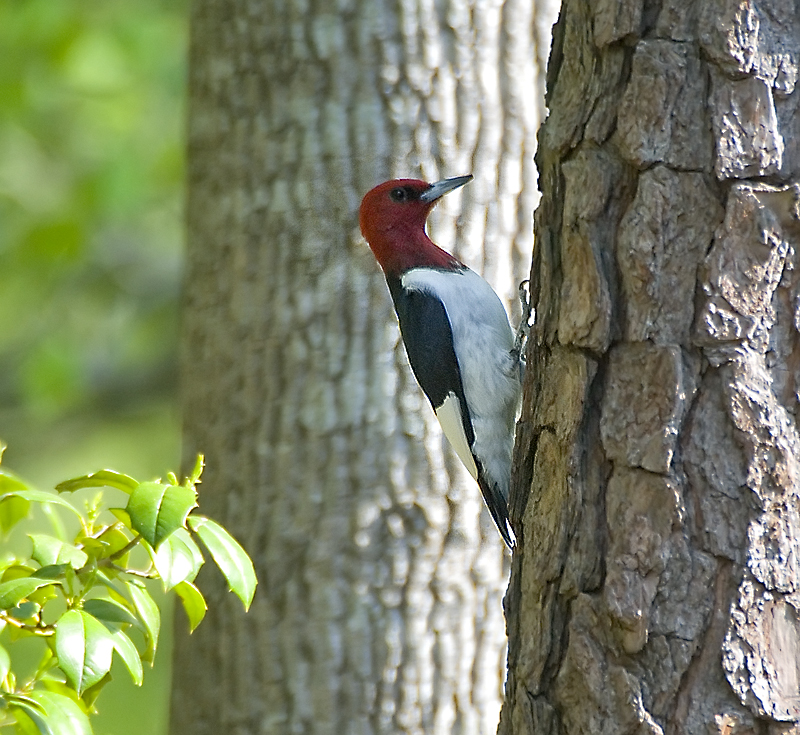


More from the family Picidae


Frequently asked questions
What does an Acorn woodpecker sound like?
You can hear 1 recording of the Acorn woodpecker on this page, including its call. Bird vocalisations are usually divided into songs – longer, often complex phrases used to defend territory and attract mates, sung mostly by males in the breeding season – and calls: short, simple sounds for contact, alarm, begging or flight.
Is the Acorn woodpecker endangered?
The IUCN Red List classifies the Acorn woodpecker as “least concern”.
What family does the Acorn woodpecker belong to?
The Acorn woodpecker (Melanerpes formicivorus) belongs to the family Picidae in the order Piciformes.
Sources & credits
- Call · McClellan Ranch Preserve, Santa Clara, California, United… by Jonathon Jongsma – CC BY-SA 3.0 · Wikimedia Commons
- Wikidata Q368657 – CC0
- Wikipedia: Acorn woodpecker – CC BY-SA 4.0
- Photo by panza-rayada – CC BY-SA 3.0